Satellites Types Linear Icons Bundle: Visualizing Space Tech for Modern Design
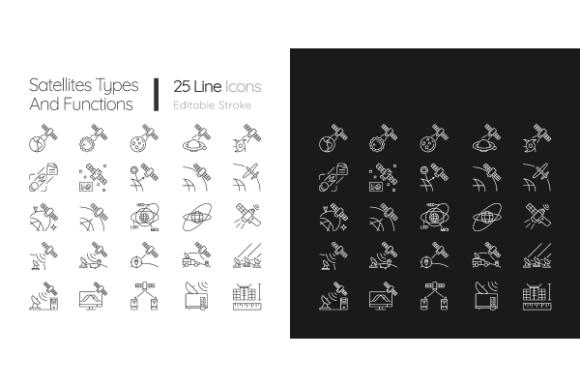
When designing interfaces or educational materials centered around aerospace, telecommunications, or celestial observation, finding visuals that balance technical accuracy with aesthetic minimalism is a genuine challenge. The Satellites Types Linear Icons Bundle addresses this specific niche by providing a comprehensive set of customizable thin line symbols tailored for both dark and light mode environments. Rather than relying on generic space clip art, this collection offers isolated vector outline illustrations that represent specific satellite architectures and exploration systems. For designers and developers working in the space sector, having access to editable stroke vectors means you can maintain brand consistency across a mobile app screen, a detailed infographic, or a printed brochure without sacrificing clarity at small sizes.
Bridging Technical Accuracy and UI Minimalism
The primary value of this bundle lies in its ability to translate complex orbital mechanics into clean, linear iconography. In user interface design, particularly for dashboard applications monitoring telemetry or fleet management, heavy or filled icons can create visual noise. Linear icons, by contrast, reduce cognitive load while retaining distinct silhouettes. Because these symbols feature an editable stroke, you are not locked into a single weight. A navigation menu on a mobile device might require a 1px stroke for elegance, while a large-format presentation slide might need a 3px stroke to remain visible from the back of the room. This flexibility is essential when the same asset library must serve multiple digital touchpoints.
Furthermore, the inclusion of assets optimized for both dark and light modes solves a common friction point in modern UI development. Space-themed applications frequently default to dark backgrounds to mimic the void of space or to reduce eye strain during night operations. However, marketing materials and documentation often utilize white or light gray backgrounds. Having pre-adapted versions ensures that contrast ratios meet accessibility standards without requiring manual color adjustments for every single asset. This saves significant time during the handoff between design and development teams.
Practical Applications Across Industries
While the subject matter is specialized, the utility of the Satellites Types Linear Icons Bundle extends across several distinct professional fields. Understanding how different sectors leverage these assets helps clarify their practical worth beyond simple decoration.
Aerospace Education and E-Learning
For educators creating courseware on orbital dynamics or space history, visual differentiation is key. Students often struggle to distinguish between geostationary communication satellites, low-earth orbit observation platforms, and deep space probes. Using distinct linear icons for each type creates a visual shorthand that aids memory retention. In an interactive e-learning module, these icons can serve as navigation anchors or progress indicators. The thin-line aesthetic feels modern and academic, avoiding the cartoonish look that can undermine serious scientific content.
Telecommunications and IoT Dashboards
Companies managing satellite internet constellations or remote IoT sensor networks rely heavily on data visualization. When building status dashboards, engineers need icons that represent hardware states clearly at a glance. A linear icon set allows for subtle state changes—such as altering the stroke color to indicate signal loss or active transmission—without changing the fundamental shape. Because these are vector-based, they render crisply on high-DPI monitoring screens used in network operation centers. The ability to customize the outline also allows companies to align technical diagrams with corporate branding guidelines, ensuring that internal tools feel as polished as customer-facing products.
Science Journalism and Infographics
Journalists and content creators covering the "New Space" economy often need to explain complex missions quickly. Whether illustrating an article about Starlink deployments or a report on climate monitoring satellites, custom illustration is expensive and time-consuming. This bundle provides a middle ground between stock photography and bespoke art. The isolated vector nature of the illustrations means they can be composited easily over maps, charts, or photographs. For print media, the availability of EPS and AI formats ensures that the lines remain sharp regardless of scaling, which is critical for high-quality magazine layouts or annual reports.
Navigating File Formats and Workflow Integration
Choosing the right format from the bundle is just as important as choosing the right icon. The collection includes JPEG, AI, PNG, EPS, and SVG files, each serving a specific purpose in a production pipeline. Understanding these distinctions prevents workflow bottlenecks.
- SVG (Scalable Vector Graphics): The gold standard for web and app development. SVGs are code-based, meaning they are searchable, animatable via CSS/JS, and infinitely scalable without file size penalties. Use these for responsive websites and mobile interfaces.
- AI and EPS: Essential for print designers and those working in Adobe Illustrator. These formats preserve layer information and editable paths, allowing for deep customization of anchor points and stroke profiles. They are ideal for brochure templates and large-format signage.
- PNG: Best for quick mockups, presentations, or non-designer stakeholders who need to drop an icon into a Word document or PowerPoint slide. Ensure you select the transparent background version to avoid unsightly white boxes.
- JPEG: Generally less useful for icons due to compression artifacts and lack of transparency, but helpful for thumbnail previews or cataloging assets within digital asset management systems.
Before integrating these assets, consider your team's technical capacity. While the editable stroke feature is powerful, it requires vector editing software to modify. If your workflow is strictly raster-based or limited to tools like Canva, you may want to export your customized versions as PNGs first to ensure consistency. Additionally, verify that the linear style matches your existing design system. Mixing thick, filled glyphs with these delicate thin-line symbols can create visual dissonance. It is often best to use this bundle as a complete replacement for your space-related iconography rather than supplementing an existing mismatched set.
Strategic Considerations for Asset Selection
When evaluating the Satellites Types Linear Icons Bundle, look beyond the immediate visual appeal and assess long-term viability. Space technology evolves rapidly; an icon representing a satellite bus from the 1990s may look anachronistic in a piece about next-generation reusable launch vehicles. This collection’s focus on generalized yet accurate types helps future-proof your designs. However, always cross-reference specific mission requirements. If you are designing for a highly technical engineering audience that demands schematic-level precision, stylized icons may need to be supplemented with technical drawings. For general communication, marketing, and UX, however, this level of abstraction is usually the sweet spot.
Another consideration is licensing and scalability. Sourcing individual icons from disparate artists leads to style drift and licensing headaches. Acquiring a cohesive bundle from a provider like BSD studio ensures that every asset shares the same corner radius, stroke weight logic, and optical sizing. This uniformity is what separates professional design from amateur assembly. It also streamlines the search process; instead of spending hours hunting for a specific "cube sat" icon that matches your "rocket" icon, you have a verified set ready for deployment.
Enhancing Creative Efficiency Without Compromise
Ultimately, the goal of utilizing specialized asset packs is to reclaim time for higher-level creative problem solving. Design work involves enough repetitive tasks; searching for consistent imagery shouldn't be one of them. By leveraging a dedicated resource for celestial bodies observation and exploration systems, you eliminate the friction of creation. The result is faster iteration cycles and more polished final deliverables. Whether you are prototyping a new app screen page or laying out an educational poster, having reliable, editable, and aesthetically versatile tools at your disposal transforms the design process from a scavenger hunt into a streamlined production. Count on specialized resources to handle the details so you can focus on the narrative and functionality of your project.