Hexone Keynote Template: Evaluating Structure, Visual Assets, and Workflow Efficiency
Selecting a presentation template is rarely just about aesthetics; it is fundamentally a decision about workflow efficiency and narrative structure. When evaluating the Hexone Keynote Template, professionals should look beyond the surface-level design and assess how its architecture supports long-term content creation. Hexone distinguishes itself through a specific organizational logic: providing 150 total slides distributed across five distinct color themes, rather than offering 150 variations of the same layout. This distinction matters significantly for users who need to maintain brand consistency across multiple projects or departments without spending hours adjusting individual slide masters.
For adults comparing presentation resources, the primary value proposition of Hexone lies in its balance of volume and curation. Many templates on the market offer thousands of slides, but this abundance often leads to decision paralysis and inconsistent design quality. Hexone takes a more restrained approach, offering 30 unique, high-utility slides per color variation. This structure suggests a focus on practical application over sheer quantity. Understanding whether this curated approach aligns with your specific presentation needs requires a closer look at its technical features, asset quality, and limitations compared to other market alternatives.
Structural Organization and Color Variation Strategy
The most critical differentiator for Hexone is its file organization. The package includes five separate PPTX files, each representing a complete, standalone presentation theme. This contrasts with templates that house every color variation within a single master file. For researchers and corporate communicators, this separation offers tangible workflow benefits. It reduces file size, improves rendering performance in Keynote, and eliminates the risk of accidentally applying the wrong master slide during high-pressure editing sessions.
Each of the five premade colors serves as a self-contained ecosystem. Rather than simply swapping accent colors on identical backgrounds, these variations allow for distinct tonal shifts suitable for different contexts. A darker palette might be appropriate for executive summaries or tech-focused portfolio reviews, while a lighter variation could better serve educational workshops or marketing proposals. Having 30 dedicated slides per theme ensures that every layout has been optimized for that specific color contrast ratio, addressing a common accessibility failure found in templates where color swaps are automated rather than handcrafted.
However, this structure also presents a tradeoff. Users who frequently switch between brand colors mid-presentation may find managing five separate files cumbersome compared to a unified system. If your workflow requires dynamic theming within a single deck, you must evaluate whether the stability of separate files outweighs the convenience of an integrated color switcher.
Asset Quality: Handcrafted Infographics vs. Generic Vectors
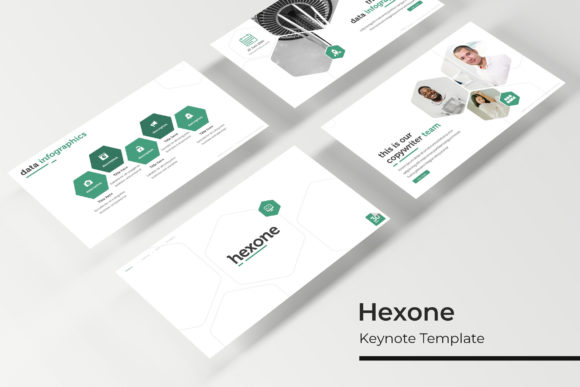
In the category of business presentations, data visualization is often the weakest link. Many templates rely on generic, auto-generated charts that break when data is updated or lack visual polish. Hexone addresses this through handcrafted infographic slides. These are not merely placeholder charts; they are pixel-perfect illustrations designed to communicate complex information clearly.
When comparing Hexone to standard office suite defaults or lower-tier marketplace templates, the difference in "editability" becomes apparent. True editability means being able to change data points, resize elements, and adjust colors without distorting the graphic. Hexone’s vector-based approach allows for resizing without pixelation, which is essential for users presenting on varying screen sizes from mobile devices to large conference displays. The graphics are built on master slides, ensuring that global changes propagate correctly throughout the deck.
This level of craftsmanship positions Hexone as a strong alternative to hiring a freelance designer for one-off projects. While custom illustration offers unlimited creative freedom, it comes with high costs and longer turnaround times. Hexone occupies a middle ground: it provides professional-grade, bespoke visuals at a fraction of the cost, provided the available styles match your data narrative. If your data requires highly specialized scientific diagrams or non-standard chart types, a template may still fall short. But for standard business metrics, timelines, and process flows, these handcrafted assets significantly reduce production time.
Evaluating Slide Utility: Galleries, Portfolios, and Breaks
A template with 150 slides can easily become bloated if those slides lack functional diversity. Hexone’s inclusion of specific utility categories—Gallery, Portfolio, and Section Break slides—indicates a design philosophy rooted in storytelling rather than decoration. Section breaks, in particular, are often overlooked in template evaluation, yet they are crucial for audience retention. Well-designed transition slides help reset viewer attention and provide clear navigational cues during long presentations.
The Gallery and Portfolio layouts deserve specific scrutiny for professionals in creative or service-based industries. Unlike standard image grids, these layouts typically account for variable aspect ratios and caption hierarchies. When comparing options, test how easily you can replace placeholders. Hexone utilizes drag-and-drop picture placeholders based on master slides. This feature streamlines the replacement process, preventing images from stretching or cropping awkwardly—a frequent frustration with poorly coded templates.
For users deciding between Hexone and a general-purpose corporate template, consider your content mix. If 80% of your slides are bullet points and text, a simpler template may suffice. However, if your presentations rely heavily on visual evidence, case studies, or product showcases, the specialized gallery and portfolio slides in Hexone offer a structural advantage that generic templates cannot replicate.
Technical Specifications and Compatibility Considerations
Before purchasing, it is vital to verify technical compatibility with your existing ecosystem. Hexone is delivered in PPTX format, ensuring broad compatibility with Microsoft PowerPoint, Keynote (via import), and Google Slides. The inclusion of both standard and widescreen versions acknowledges the reality of modern hybrid work environments where presentations are viewed on everything from ultrawide monitors to tablets.
The package includes a Readme file and links to free font downloads. This transparency regarding typography is a positive signal of quality. Many templates use premium fonts that require additional licensing fees, creating hidden costs. By specifying free fonts, Hexone ensures that the design remains accessible and legally compliant for commercial use. Always verify that the linked fonts are still active and compatible with your operating system before committing to the template.
A crucial limitation to note, consistent with industry standards, is that preview photographs are not included. All images are for illustration purposes only. This is standard practice, but it impacts the "out-of-box" experience. Users must have their own high-quality imagery ready to achieve the polished look seen in previews. If you lack access to stock photography or original assets, the template will feel incomplete regardless of its structural quality. Factor the time and cost of sourcing appropriate imagery into your overall project evaluation.
Decision Framework: When Hexone Fits and When It Doesn’t
Determining whether Hexone is the right resource requires an honest assessment of your current pain points. This template is likely a strong fit if:
- You manage multiple brands or sub-brands: The five distinct color files allow you to maintain separate, clean master decks for each entity without cross-contamination.
- Data visualization is a bottleneck: You spend excessive time formatting charts and need pre-built, editable infographics that look professional immediately.
- You present across varied formats: The inclusion of both standard and widescreen ratios future-proofs your content for different venues.
- You value curation over volume: You prefer 30 highly functional slides over hundreds of redundant options that slow down decision-making.
Conversely, Hexone may not be the optimal choice if:
- You require deep animation libraries: While functional, this template focuses on static design and layout structure rather than complex motion graphics or video integration.
- Your content is purely text-heavy: If your presentations are academic papers or policy documents with minimal visual components, the gallery and portfolio features add unnecessary overhead.
- You need real-time collaborative theming: As noted, the separate file structure is great for organization but less ideal for teams needing to swap themes dynamically within a shared cloud document.
- You lack image assets: Without your own photography, the visual impact of the template diminishes significantly.
Comparative Value in the Professional Market
In the broader landscape of presentation resources, Hexone competes not just with other templates, but with AI-generated slide tools and custom design services. AI tools excel at generating content quickly but often struggle with pixel-perfect alignment and brand-specific nuance. Custom designers offer perfection but at a premium price point and slower speed. Hexone sits firmly in the professional DIY segment, empowering competent users to produce agency-quality work independently.
When evaluating ROI, consider the longevity of the asset. Because Hexone relies on master slides and vector graphics rather than flattened images or trendy effects, it is more likely to remain usable as design trends evolve. The "handcrafted" nature of the infographics implies a level of geometric precision that ages better than stylized, decorative elements. For professionals who view presentation templates as long-term infrastructure rather than disposable skins, this durability is a key decision factor.
Ultimately, the choice depends on aligning the tool’s strengths with your specific operational constraints. Hexone offers a robust, well-organized foundation for visual communication, particularly for users who value structural integrity and data clarity over infinite variety. By understanding its specific architecture—the five-file system, the curated slide counts, and the master-slide dependencies—you can make an informed decision that supports both your immediate presentation goals and your long-term workflow efficiency.