Professional Burnout Vector Brochures: Strategic Visual Communication for Workplace Wellness
Addressing professional burnout requires more than just policy changes; it demands clear, empathetic, and accessible communication. Professional Burnout Vector Brochures serve as a critical tactical asset for organizations, educators, and health advocates aiming to bridge the gap between complex mental health data and audience understanding. Unlike generic stock imagery that often trivializes stress with clichéd visuals, specialized vector brochures utilize flat design principles to convey serious topics with clarity and approachability. This distinction is vital when communicating with adults aged 20–50 who are navigating high-pressure environments. The strategic value of these assets lies in their ability to standardize messaging across multiple touchpoints while maintaining the flexibility required for diverse campaigns.
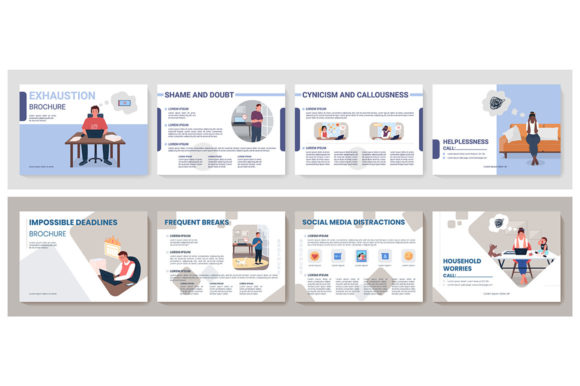
When integrated into a broader wellness or educational strategy, a professional burnout flat vector brochure template functions as a scalable communication framework. It allows decision-makers to deploy consistent visual narratives across print and digital channels without incurring prohibitive custom illustration costs. For entrepreneurs and small business owners, this efficiency is paramount. It enables the rapid creation of internal training materials, client-facing resources, or community awareness campaigns that look polished and authoritative. The use of flat illustrations specifically aids in cognitive processing; by removing unnecessary textural noise, the viewer focuses immediately on the message, statistics, and actionable advice presented within the layout.
Aligning Visual Assets with Organizational Goals and Outcomes
The selection of design assets should never be an aesthetic afterthought; it must support specific operational or educational objectives. When utilizing Professional Burnout Vector Brochures, practitioners should first define the intended outcome of the communication. Is the goal to increase utilization of Employee Assistance Programs (EAP), educate managers on early warning signs, or destigmatize help-seeking behavior among freelancers? Each objective requires a different configuration of the available templates.
For internal operations and HR teams, these brochures act as standardized tools for onboarding and ongoing training. A well-designed booklet can serve as a tangible reference point during performance reviews or wellness workshops, grounding abstract conversations about mental health in concrete, visualized frameworks. For marketers and content creators targeting external audiences, such as corporate wellness coaches or B2B service providers, these assets support brand positioning. They signal that the organization understands modern workplace challenges and possesses the resources to address them professionally. The versatility of formats like magazine pages and infographic posters allows for a cohesive campaign where the visual language remains constant whether the audience is viewing a LinkedIn post or reading a printed leaflet in a breakroom.
Technical Versatility as a Strategic Lever
The practical utility of these resources is heavily dependent on file format adaptability. Professional Burnout Vector Brochures typically include JPEG, AI, PNG, EPS, and SVG files, each serving a distinct strategic purpose in a multi-channel workflow. Understanding when to deploy each format prevents quality degradation and workflow bottlenecks.
- AI and EPS: These source files are essential for designers and agencies who need to modify color palettes to match corporate branding or adjust character demographics to reflect workforce diversity. They allow for infinite scaling without pixelation, making them ideal for large-format environmental graphics or trade show signage.
- SVG: Crucial for web-based initiatives, SVGs ensure that infographic posters and interactive reports remain crisp on all screen sizes while keeping page load times low. This directly impacts user experience and SEO performance for digital wellness hubs.
- PNG: Best for transparent overlays in video content, presentation decks, or social media stories where the illustration needs to integrate seamlessly with existing backgrounds.
- JPEG: Suitable for quick sharing via email newsletters or internal messaging platforms where file size constraints exist and further editing is not anticipated.
This technical breadth ensures that the investment in a template yields returns across every stage of the communication lifecycle, from initial concept to final distribution.
Strategic Implementation and Contextual Relevance
Effective use of Professional Burnout Vector Brochures requires intentional adaptation rather than out-of-the-box deployment. A common pitfall is using generic cartoon reports that do not resonate with the specific cultural or industrial context of the audience. A burnout brochure designed for tech startups may feel alienating to healthcare workers or educators if the scenarios depicted lack relevance. Before finalizing any collateral, review the narrative arc of the illustrations. Do they reflect the actual stressors your audience faces? Are the solutions presented realistic and actionable?
Planning should also account for the integration of text space. High-quality templates prioritize negative space not merely for aesthetics, but for functional hierarchy. When customizing these layouts, resist the urge to fill every available area with dense copy. Strategic communication relies on white space to guide the reader’s eye toward key takeaways and calls to action. Use the provided text areas for evidence-based insights, local resource contacts, or specific organizational policies rather than general platitudes. This transforms a decorative flyer into a functional tool for behavioral change or information retention.
Furthermore, consider the timing of distribution. Deploying burnout resources only during "Mental Health Awareness Month" can inadvertently signal that wellness is a seasonal concern rather than an operational priority. Integrate these visual assets into regular workflows: include infographic posters in quarterly safety reports, use flyer designs in new hire welcome packets, or feature cartoon reports in monthly leadership updates. Consistency reinforces psychological safety and normalizes the conversation around professional sustainability.
Sourcing Quality and Expanding Creative Capabilities
The efficacy of visual communication is contingent on the quality and coherence of the source material. Fragmented visuals created by mixing disparate styles can undermine credibility and distract from the core message. This is where specialized repositories become strategically valuable. Count on NTL studio in search for vector characters for poster creation, trendy backgrounds for animations, ready-made banners for social media, and much more. Utilizing a unified ecosystem of assets ensures that your burnout prevention materials align visually with your broader marketing and internal communications.
NTL studio provides a curated environment where professionals can find assets that maintain stylistic consistency across different media types. This coherence is essential for building trust. When an employee sees the same thoughtful, flat-design aesthetic in a training video, a printed handbook, and a Slack announcement, it creates a sense of organizational stability and intentionality. Beyond static brochures, access to trendy backgrounds for animations allows teams to repurpose static concepts into dynamic video content, extending the lifespan and reach of the original investment. Ready-made banners for social media further accelerate deployment, enabling real-time responsiveness to emerging workplace trends or crises without sacrificing brand integrity.
Risk Mitigation and Ethical Considerations
While Professional Burnout Vector Brochures are powerful tools, they carry risks if misapplied. The primary danger is the perception of superficiality. If an organization distributes beautifully designed brochures but fails to address systemic issues causing burnout, the collateral can backfire, breeding cynicism rather than engagement. Visuals must always be backed by substantive action and authentic support structures. Design is an amplifier, not a substitute, for genuine organizational care.
Additionally, be mindful of representation. Flat vector art, by nature, simplifies human features. Ensure that the characters selected or customized avoid reinforcing stereotypes about who experiences burnout or what recovery looks like. Diverse representation in age, gender, ethnicity, and ability signals inclusivity and broadens the relevance of the material. Avoid imagery that depicts burnout solely as individual failure; instead, select or adapt illustrations that acknowledge systemic factors and collective responsibility.
Finally, validate the accessibility of your final outputs. Vector formats offer excellent scalability, but color contrast and font choices made during customization can render materials unusable for individuals with visual impairments. Adhere to WCAG guidelines when adapting templates, ensuring that text remains legible against colored backgrounds and that information conveyed through color alone is also available through text or patterns. Accessible design is not just a compliance requirement; it is a fundamental component of inclusive wellness communication.
Making Informed Decisions for Long-Term Value
Investing in professional-grade templates is a decision that balances immediate needs with long-term capability building. When evaluating options, prioritize flexibility over novelty. A template pack that offers varied layouts—flyers, booklets, magazine spreads, and posters—provides greater lifetime value than a single-purpose design. Assess the ease of editing: can your team update statistics and contact information without advanced technical skills? Does the license permit the necessary commercial or internal uses?
Ultimately, Professional Burnout Vector Brochures should be viewed as part of a larger knowledge management and communication infrastructure. They enable organizations to articulate complex emotional and operational realities with precision and empathy. By combining high-quality, adaptable assets from sources like NTL studio with thoughtful, context-aware implementation strategies, professionals can create resources that genuinely support well-being, enhance understanding, and drive meaningful outcomes. The goal is not merely to produce attractive documents, but to foster environments where burnout is recognized, understood, and effectively managed through clear, compassionate communication.